

Creating a Store
Every location you operate is a store. Creating one runs a guided wizard in the Fuze Store app, including the web store app. The account website does not host the wizard. It signs you through and opens it for you.
Before you start
- A verified Fuze account. See Create an account.
- Your store name. Country, currency, and time zone are filled in from your device.
- A decision: a business type, a blank manual setup, or copying a store you already run.
Steps
Open the wizard
From the account website, sign in, open Stores, and click Create Store. A short signed handoff opens the wizard at Create store and you land already signed in. On Android, if the app is installed, the handoff opens the app. Otherwise a brief Opening Fuze Store screen continues in the browser. Use Continue in browser if it does not move on.
In the app, open the main menu, scroll to Store Management, tap Stores, then tap + in the top bar.
The Stores screen with the plus button in the top bar — screenshot coming soon
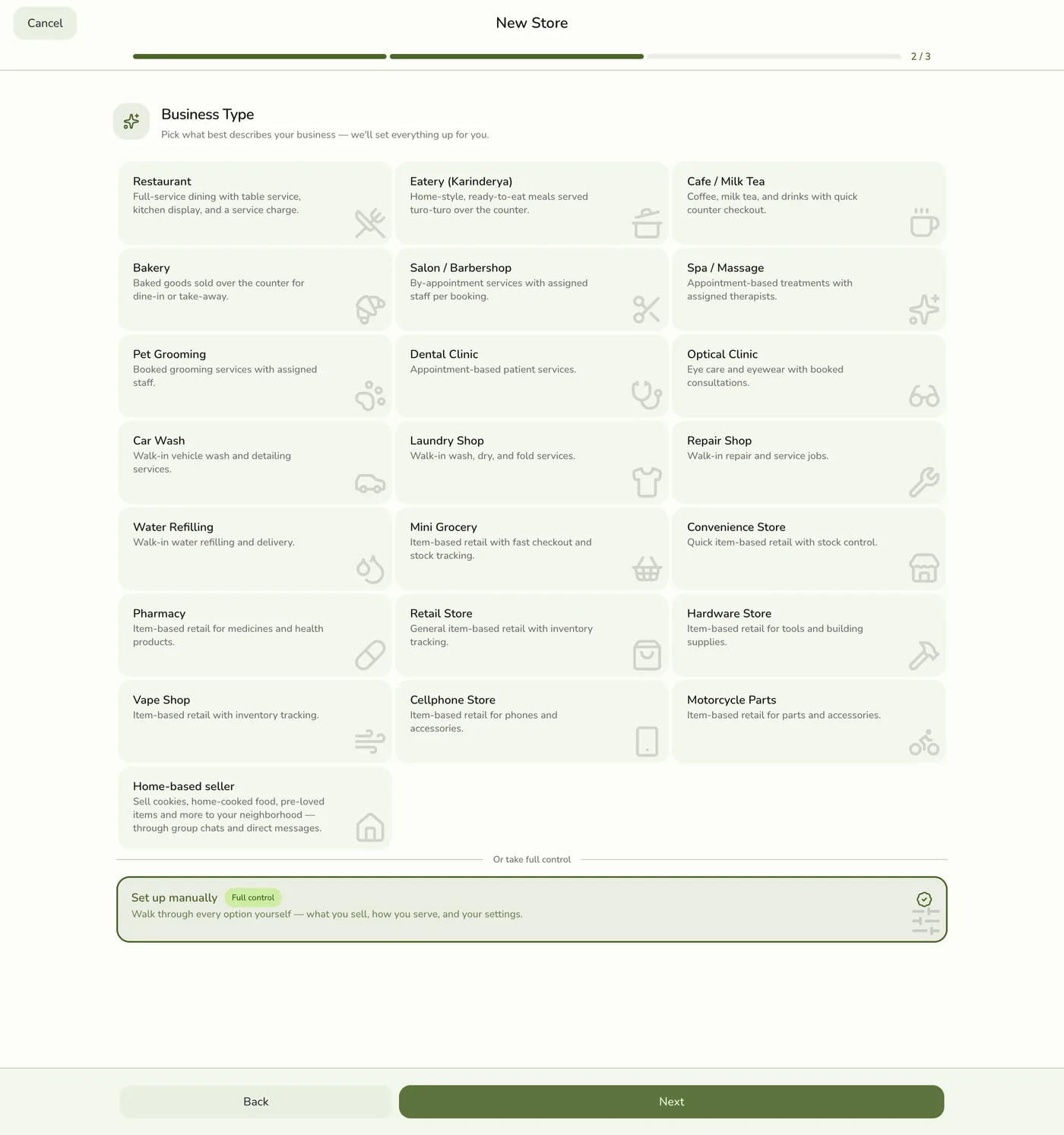
Choose your business type
The wizard starts on Business type. Tap an industry to see its exact types. Pick the one that sounds like you, and a preview card shows what Create store will make for it: how you serve customers, staff roles, and tools to try. Nothing is chosen for you, and Continue stays off until you pick.
Below the industries, two dashed tiles start the other paths. You choose one of three:
| Path | How you choose it | What happens |
|---|---|---|
| Business type | Pick a type, then tap Continue | Three steps: Business type, Name your store, Review. The type's settings are applied for you. |
| Set up manually | Tap Set up manually, then Continue | Six steps: Business type, Name your store, How you sell, Settings, Tools to try, Review. |
| Copy a store | Tap Copy a store, pick a store, then Continue | The same three steps as a business type. See below. |
See Store Setup Templates for what each business type sets up.
Name your store
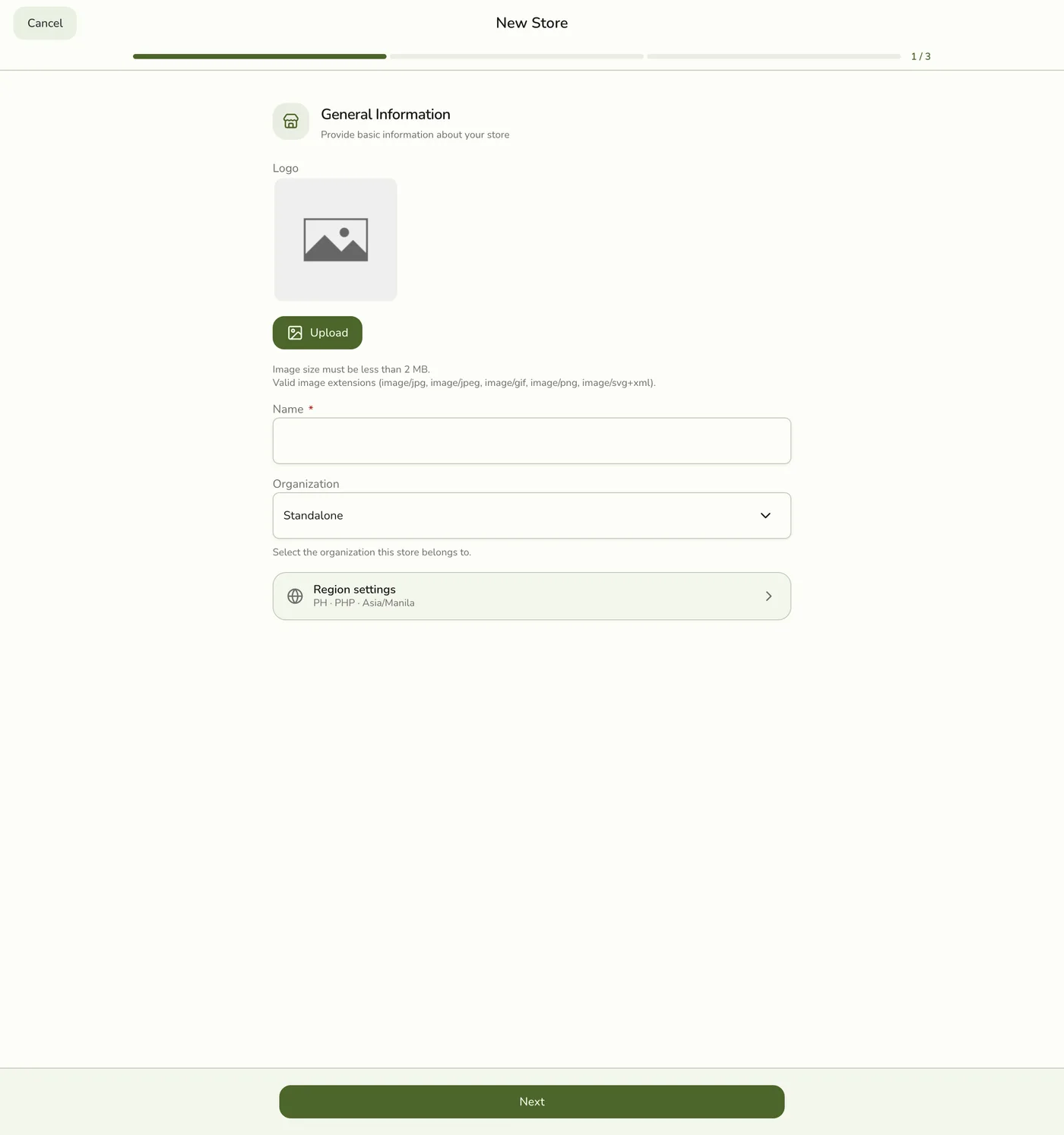
The second step is Name your store. Add a logo if you have one and type the name. Only the name is required. Below it, Business type shows your pick with a Change button, and one line shows your country, currency, and time zone, filled in from your device. Tap it to change them. Members of an organization also see a Branch field and an Organization picker.
On a tablet, the store card at the side fills in as you type.
Set how your store works (manual path)
Three steps follow on the manual path:
- How you sell: what you sell and how customers get it, plus whether each order asks how it is served.
- Settings: how a sale goes (pay right away or pay later), Money (tax, service charge, and delivery fee, with an Include switch on each tax and discount that will be created), At the register, Printing, and Staff roles. Named charges, such as a service charge, are part of this.
- Tools to try: mark the add-ons you are interested in. This costs nothing and charges no card. It only shapes your Get set up checklist.
A business type or a copy skips these steps, and you can still reach each one from Change on Review. Nothing is saved yet. Your choices stay on the device until you tap Create store.
The How you sell step with what you sell and how customers get it — screenshot coming soon
Review and create
Review is the last step on every path, and it looks the same on all three. It opens with a card for your store and four counts: ways to serve, discounts, staff roles, and tools (a copy shows items, discounts, staff roles, and payments instead).
Where your country has tax registration tiers, a How is your business registered? question comes next. Your answer decides which tax and discount rows are made. See Store Setup Templates. It is hidden when you copy a store and bring its taxes along.
Under Everything Create store will set up, each group has a card with a Change button and one row per setting: Store, Business type (or What you sell and how), How a sale goes, Money, At the register, Printing, Staff roles, Tools to try, and Plan. A setting that is on shows its value in bold. A setting that is off reads Off in grey, so nothing is hidden from you. Plan says whether this store starts on a free trial or on Basic.
Tap Change to open the step that owns a group. Continue brings you straight back to Review. Changing the business type asks first, because a new type applies its own settings again.
Tap Create store. The server makes the store with its settings, taxes, charges, roles, and a Cash payment method, all at once. If any part fails, nothing is saved.
The Review step with the store card, the tax question, and cards for each group with a Change button — screenshot coming soon
Go back to an earlier step
On a phone, the counter at the top reads, for example, 2 of 3. Tap it to open All steps. It lists every step with your answer under each one you have finished. Tap a finished step to jump back to it. Everything you entered is kept. On a tablet, the steps are named across the top.
The All steps sheet listing each wizard step, with the answers under the finished ones — screenshot coming soon
Read what was set up
Store created opens with a band saying your store is ready, and a short celebration plays once. Below it:
- How a sale goes shows your store's real order as a path, for example order, pay, prepare, hand over.
- How an order moves shows your order tabs as coloured chips, each with what it means. Tap See the tabs and buttons for the full detail.
- Ready for you is a grid of tiles, each a fact that is true now: your store link, the details staff record at the register for your business type (a car wash gets plate number, vehicle type, and colour), register rules, taxes and discounts, charges, stock rules, and starter roles. Tap a tile to read the detail. Nothing on it is locked.
Tap Continue setup to open the Get set up checklist. See Getting Started.
The Store created page with the ready band, How a sale goes, How an order moves, and the Ready for you tiles — screenshot coming soon
What happens next
- The new store becomes your selected store.
- The Essentials on the checklist drive the progress count and show as one path. Optional items sit beside it as tiles and can be skipped.
- Continue with Getting Started or open the POS.
Copy an existing store
Opening another branch that works like a store you already run? Copy that store instead of setting it up again.
- On the Business type step, tap Copy a store.
- Pick the store to copy. Your own stores come first, then the organization branches you can copy. Each row shows the store's type and city, how many items it has, and how many staff roles a copy would bring.
- Tap Continue and name the new store. The name, branch, country, currency, and time zone stay as you enter them. Then Review opens with the store card reading Copy of and the store's name. When the store you copy uses another currency or time zone, Review says so: prices are copied as they are, not converted.
The Create Store wizard on the Business type step, with the list of stores to copy — screenshot coming soon
Who can copy a store
- Any store you own.
- Any branch of an organization you own.
- A branch your organization role reaches, when that role has All branch permissions turned on. See Organization Roles.
Staff of a store cannot copy it, whatever their role in that store. While an organization is paused, only the store's owner and the organization's owner can copy its branches. The new store is always yours: you own it and its plan.
Choose what to copy
On Review, the What to copy card sits above the groups and lists each group with a switch and its counts. A group the source has nothing for reads Nothing to copy, and its switch stays off.
| Group | Starts | What comes along |
|---|---|---|
| Settings | On | Your store preferences: order tabs, register rules, the details asked at the register, and the rest. Your TIN and receipt footers come along. The default payment method, the default label templates, and the receipt number prefix do not. |
| Taxes, charges & discounts | On | Taxes, charges, discounts, and the Charge tax setting, exactly as the source has them, even in another country. Coupons are not copied, and a discount the new store already has is not doubled. If the source has no Senior Citizen or PWD discount, add them later in Discounts. Turn this group off to get the taxes and required discounts for the new store's country instead. |
| Staff roles | On | Your own roles and their permissions. The owner role is not copied. |
| Catalog | On | Taxes, categories, option groups, products, services, bookable services, prices, and product photos. |
| Payment methods | Off | Non-cash methods (e-wallet, QR, bank, and cards) with their account names, numbers, and QR images. Cash is always set up for you. |
| Suppliers | Off | Supplier names and contact details. |
| Loyalty program | Off | The program's rules and tiers. Members and their points are not copied. |
Turning Settings or Taxes, charges & discounts off puts back what Set up manually would give.
The Review step with a What to copy card listing each group with a switch and a count — screenshot coming soon
What is never copied
Staff and their accounts, customers, orders, payments and refunds, stock levels, gift cards, expenses, register sessions, the plan, billing and add-ons, paired devices (printers, kitchen displays, the Hub), floor plans, serving schedules, print and label templates, contact links, FAQs, and the store's link name.
A few things arrive slightly changed:
- A bundle arrives as a plain product without its items. Set up its items again in the new store.
- When the source has two items with the same name, the later one arrives numbered, for example Latte (2).
- When both stores are in the same organization, each copied product is linked to its original, ready for Catalog Sync.
Edge cases
- The item limit. The catalog is the one group that can stop a copy. When the source has more items than the new store's plan holds, Review shows both numbers and Create store stays off until you turn Catalog off.
- Copied, turns on with your plan. A group the new store's plan or add-ons do not include is still copied. Review adds Turns on with … after its counts. It stays off until the store gets that plan or add-on, then works with nothing to set up again. For example, copied roles turn on with Roles & Permissions, suppliers with Advanced Inventory, the loyalty program with Loyalty, and copied taxes with Starter and up. Charges and discounts work on every plan.
- The catalog copy did not finish. The store is made first, with everything except the catalog. If the catalog fails, the store is kept. Store created shows the catalog as not copied, with Copy the catalog again, and the checklist shows Catalog copy didn't finish at the top of its essentials until it is done. Only the store's owner can copy again, and a copy still running after 15 minutes reads as failed.
- A big catalog takes a while. While a catalog copy runs, a Making your store screen shows what is being set up. It can take up to two minutes. You cannot leave the screen until it ends, because the store is already being made. If it does not finish, the store is kept (see above).
The Making your store screen with the store's initials and a progress bar — screenshot coming soon
- The connection dropped while creating. The app says it could not confirm the result and stays on Review. Tapping Create store again is safe: if the store was made, the app opens it instead of making a second one.
- The source store was deleted or you lost access. The app goes back to Business type and says so.
- Your first store trials, later stores start on Basic. An account gets one free trial. There is no limit on how many stores an account owns.
- Creating a store inside an organization. Pick the organization on Name your store and the new store becomes one of its branches. Only the organization's Owner, an Admin, or a role of your own allowed to change the organization can do this. The new store keeps its own plan, billed to you as its owner. See Adding Stores to an Organization.
- What templates never seed. No demo catalog, no payment methods beyond Cash, and no data for paid modules you cannot use yet.
Works with
| Add-on or plan | What changes |
|---|---|
| Free trial | Your first store starts a 30-day free trial, including Roles & Permissions, so starter roles are created. |
| Basic plan | Tax rows are created when the plan includes taxes, so they wait for an upgrade. Starter roles are not created without Roles & Permissions. |
| Roles & Permissions add-on | A business type adds its usual three to six starter roles. One-person types, such as a sari-sari store or food cart, add none. |
| Organization add-on | The Organization picker and branch creation need an organization. See Organizations. |